English

Nov 11, 2025
Nineteen years ago, when we started Bojing in a 400-square-meter workshop on the outskirts of Wenzhou, the only air ring blown film cooling tool we had was a single-lip ring we machined ourselves on a second-hand lathe. The bubble wobbled like a kite in a typhoon, and the customer in Ningbo threatened to cancel the order. That night we learned the hard way: cooling isn’t just about blowing air—it’s about controlling where, how fast, and how evenly that air hits the melt.
Today we ship air ring blown film cooling systems to 41 countries, and every design still carries the scars of that first failure. This article is the playbook we wish we’d had back then.
Polymer leaves the die at 195–220 °C. In the first 50 mm above the die face, viscosity drops three orders of magnitude. If you cool too slowly, the film necks in and you get hourglass gauge. Cool too fast and you freeze orientation before the bubble can stretch.
The air ring blown film cooling job is to thread that needle. High-velocity air (28–36 m/s) exits the lip gap at 0.8–1.2 mm. Static pressure drops from 1,200 Pa at the lip to ambient in 80 mm. That pressure gradient is what pins the bubble and sets the frost line.
Miss by 5 % in velocity symmetry and you’ll see a 3 % gauge band 20 meters downstream. We measure every ring on a 48-point laser grid before it leaves the factory.
| Lip Design | Exit Velocity | Typical Frost Line | Best For |
|---|---|---|---|
| Single | 22–26 m/s | 1.1–1.8 DD | LDPE < 30 μm, low output |
| Dual | 30–38 m/s | 2.0–4.5 DD | LLDPE 25–80 μm, 250–380 kg/h |
| Triple | 32–42 m/s | 3.5–6.0 DD | HDPE high-stalk, > 400 kg/h |
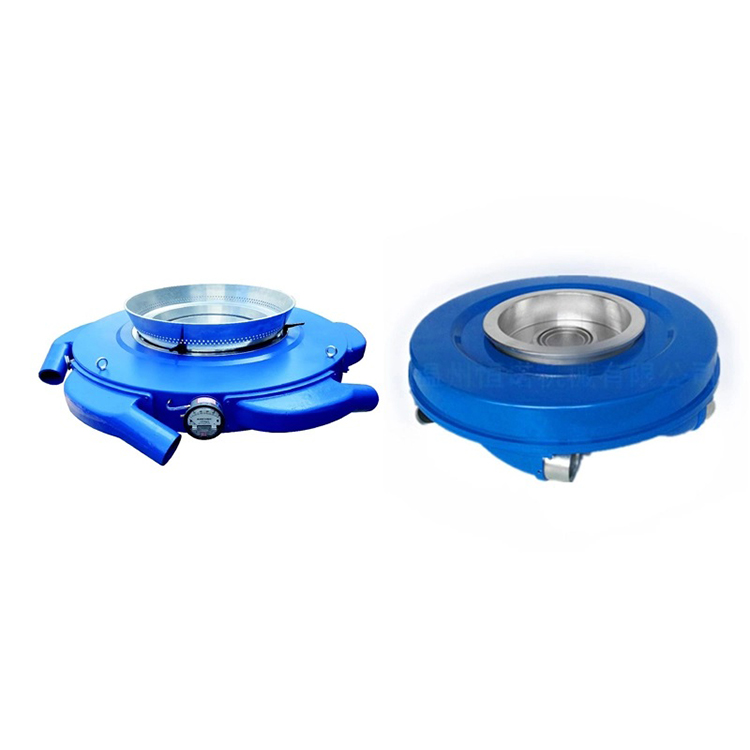
A dual-lip air ring blown film cooling system splits the flow: the lower lip stabilizes, the upper lip accelerates. The gap between lips is 18–22 mm on our BJ-650Pro. Too close and you get venturi suction that pulls the bubble inward; too far and the flows decouple, creating longitudinal stripes.
We run CFD on every new die diameter. Last month we caught a 3 mm lip offset on a 900 mm ring that would have caused ±7 % gauge variation. Fixed it before the steel was cut.
Between the upper lip and the first collimator sits a 60–80 mm aluminum cone. Air clings to it via Coanda effect, forming a 360° laminar curtain. Drill one wrong hole in that cone and you create a low-pressure streak that shows up as a thin line in the final roll.
Our QC team checks cone surface finish with a 0.01 mm dial gauge. Anything rougher than Ra 0.8 gets polished again.
Frost line height isn’t just a number on a spec sheet. Move it from 2 DD to 4 DD and you gain 0.8 seconds of melt relaxation time. That drops orientation stress by 12–18 %, which means 30 % less shrinkage in the final bag.
But push the chimney too high on a single-lip air ring blown film cooling setup and the bubble starts to breathe—inhaling warm shop air on the upwind side, exhaling on the downwind. Result: ±15 mm layflat swing.
Modern dual-lip rings let you run chimneys up to 250 mm without breathing because the lower lip shields the base. We added adjustable lower-lip inserts on the BJ-800Pro launched in June 2025. Customers in Thailand report frost lines locked at 3.8 DD even when ambient hits 38 °C.
Every week someone calls and says, “My blower is 1,500 m³/h, why is my bubble still soft?” Because volume without velocity is just hot air.
Velocity = Volume / (2π × radius × gap height) For a 600 mm die, 1.0 mm gap, you need 1,100 m³/h to hit 34 m/s. Drop to 0.8 mm gap (common on retrofit rings) and the same blower only gives 27 m/s—frost line collapses to 1.4 DD, output falls 18 %.
We ship every air ring blown film cooling system with a velocity map. If your plant technician can’t hit ±2 m/s across 36 points, we fly out and adjust it ourselves.
Lip material: 6061-T6 aluminum, hard-anodized to 50 μm
Lip gap tolerance: ±0.02 mm (we reject 0.03 mm)
Concentricity die-to-ring: < 0.15 mm
Surface finish on air exit: Ra 0.4 or better
One customer in Brazil sent back a ring because the lip gap measured 1.22 mm on one side, 1.18 mm on the other. We ate the $2,800 freight both ways because 0.04 mm is unacceptable.
On lines running 320+ kg/h, manual valves can’t keep up with melt pump pulses. Our 36-segment piezo valves adjust in 0.3-second bursts, holding ±1.5 % gauge on 22 μm film.
Last week in Monterrey, a customer switched from manual to auto on a 550 mm die. Gauge variation dropped from ±5.8 % to ±2.1 % in 11 minutes. The operator texted me a photo of the roll—looked like glass.
Measure die face runout first. More than 0.10 mm? Fix the die before touching the air ring blown film cooling system.
Match the new ring’s lower lip diameter to the die within 0.5 mm.
Run a 30-minute heat-soak at 180 °C before final alignment—aluminum grows 0.24 mm per 100 °C.
Skip any step and you’ll chase gauge bands for weeks.
| Die Ø (mm) | Recommended Air Ring | Lip Gap (mm) | Target Velocity (m/s) | Expected Output (kg/h, 38 μm LLDPE) |
|---|---|---|---|---|
| 300–450 | BJ-450Pro | 0.9–1.1 | 32–36 | 180–260 |
| 500–700 | BJ-650Pro | 1.0–1.2 | 33–38 | 280–420 |
| 750–900 | BJ-800Pro | 1.1–1.3 | 34–40 | 450–580 |
We don’t sell hope. We sell frost lines that don’t move.
 English